
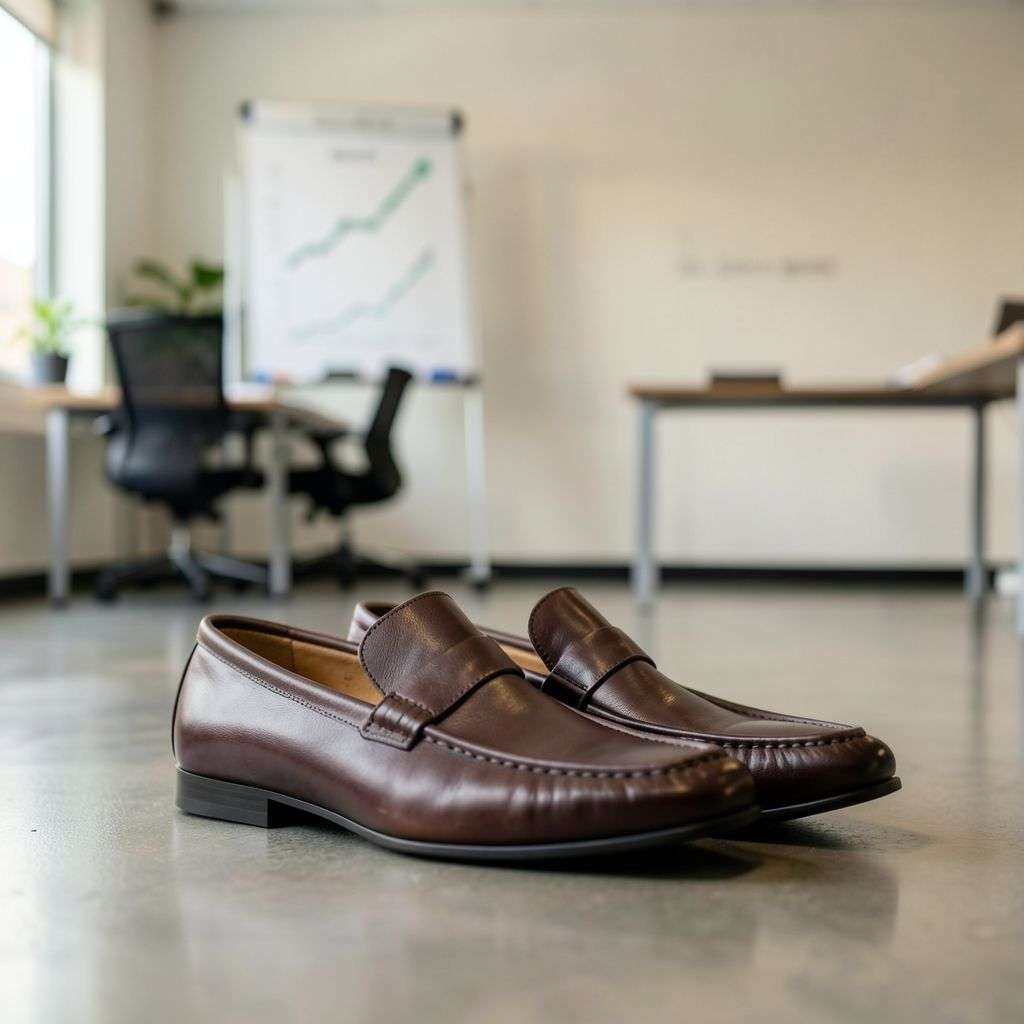
Founders who wear loafers as a deliberate uniform buy back attention, signal intent, and spend less per wear than almost anything else in their closet. flaneurs
Loafers Remove a Decision You Make Every Day

Series A founders trade on speed. You ship weekly, hire fast, and answer investors between customer calls. Every recurring decision you delete returns attention to the work that moves revenue. Footwear is one of those decisions.
Laces cost seconds, and the dress-code menu costs more. You choose sneakers for the office, lace-ups for the board meeting, and boots for the offsite. Loafers collapse that menu. You slip them on at the door and walk into a pitch, a customer demo, or a airport security line without changing anything.
Run a simple test. Wear one pair of loafers from Monday through Friday. Track how many times you swap shoes or second-guess your outfit. If the number drops, you found free time. If it stays flat, you lost nothing but a week.
Loafers also cover a wide range. They pair with chinos, dark jeans, and tailored trousers, so one pair works for a coffee chat with a candidate and a formal term-sheet meeting. That range matters when your calendar jumps from a warehouse tour to a lawyer’s office in the same afternoon. I base this on styling practice, not a study, so treat it as a working hypothesis you can verify in your own week.
Loafers Started as Work Shoes, Not Status Symbols

Real examples beat theory, so start with the original. George Henry Bass founded G.H. Bass in 1876 with a mission to make the best possible shoe for its intended use. That sounds like a product-market-fit statement, because it is one. flaneurs
In 1936, the company put a stylish spin on a Norwegian farm shoe designed for “loafing in the field”, and the Weejuns name shortens the word “Norwegian.” Bass added a small cutout for a penny, which made the original penny loafer. The company took a utility product, tweaked one feature, and gave it a name people remembered. g h bass +2
Bass did not invent status. The market supplied it. Bass still produces the penny loafer by hand, nearly a century after launch, and the design has outlasted the trends around it. Founders should recognize that pattern: function first, brand second, longevity third. analogshift
You can use the same logic on yourself. Pick the shoe that does the job, wear it consistently, and let the reputation build. Consistency compounds faster than novelty. An investor who sees you in the same sharp, simple footwear across three meetings reads reliability, and reliability matters when you ask someone to wire seven figures. That last link is my reasoning, not a research finding, so weigh it accordingly.
Loafers Signal Intent, and Intent Shapes Perception

Harvard researchers Silvia Bellezza, Francesca Gino, and Anat Keinan studied how people judge deliberate rule-breaking in formal settings. They called their finding the red sneakers effect. Their studies showed that people grant higher status and competence to nonconforming individuals, and that perceived autonomy drives those inferences. econbiz
The details matter for founders. In one study, students judged an unshaven professor in a t-shirt at a top-tier university as having more status and competence than a conventionally dressed one. The effect also came with a condition: a little flair raises perceived status and competence only when observers see it as intentional. Accidental violations of the dress code backfire. eurekalertpsychologicalscience
Here is the honest limit. The researchers tested sneakers, gym clothes, and t-shirts. They did not test loafers, so no study proves a loafer effect. My argument is an inference: loafers sit between the sneaker and the oxford, so they look chosen rather than careless. A well-kept pair at a formal meeting reads as a decision. The research says that perception drives the payoff.
Speed of judgment raises the stakes. Princeton researchers Janine Willis and Alexander Todorov found that judgments of faces after a 100-millisecond exposure correlated highly with judgments made without time limits. That study covered faces, not footwear, so do not treat your shoes as a lever. Treat them as one small detail that should not undercut the impression you build with your pitch. Careless details add noise, and loafers add very little. princeton
Famous founders show the same dynamic at the top end. The APS summary of the red sneakers research notes that certain CEOs, including Bill Gates and Mark Zuckerberg, have appeared in casual dress at business events. The lesson is not to copy a billionaire. The lesson is to look like you chose your outfit on purpose. psychologicalscience
Loafers Pay Back Faster Than Most Wardrobe Bets

ROI thinking applies to shoes too. Start with the price. Analog Shift lists the G.H. Bass Larson Weejuns loafers at $175, and prices change, so check the current number before you buy. analogshift
Now run illustrative math. Assume you wear one pair 200 days in a year. That assumption is mine, so swap in your own number. At $175, the first-year cost works out to about 88 cents per wear, and the figure keeps falling every day you keep wearing them. Compare that with the cost of a rotating cast of single-purpose shoes, each sitting unused for most of the month.
Buy with a founder’s discipline, not a shopper’s impulse:
- Start with one neutral pair. Choose black or dark brown so the loafers match everything you already own.
- Check construction. Bass describes its Weejuns as handsewn, so look for visible craftsmanship rather than a logo. ghbass
- Track wear for 30 days. Buy a second pair only if the data says you reach for the first one constantly.
- Keep them clean. Scuffed loafers read as careless, which undermines the intent signal that makes them useful.
The comfort of a slip-on also supports long days. Series A schedules stack travel, back-to-back meetings, and late nights, and shoes you can step into without thought remove one more source of friction. You do not need a spreadsheet to see the appeal, but a spreadsheet will confirm it if you want one.
Loafers will not close your round, yet they remove one daily decision and make your style look chosen instead of accidental. Small edges compound, and this one costs under a dollar a wear at 200 wears.
Written by Genzwalk.com
Sources (facts only)
- G.H. Bass history, Flâneurs: https://flaneurs.net/en/brand/86-gh-bass
- “A History of the Penny Loafer, an American Style Icon,” Analog Shift: https://www.analogshift.com/blogs/transmissions/penny-loafer-shoe-history
- “Dressing for Success: From Lucky Socks to the Red Sneaker Effect,” Association for Psychological Science: https://www.psychologicalscience.org/news/minds-business/dressing-for-success-from-lucky-socks-to-the-red-sneaker-effect.html
- Bellezza, Gino & Keinan (2014), “The Red Sneakers Effect,” Journal of Consumer Research, EurekAlert summary: https://www.eurekalert.org/news-releases/837564
- Willis & Todorov (2006), “First Impressions,” Psychological Science, Princeton: https://collaborate.princeton.edu/en/publications/first-impressions-making-up-your-mind-after-a-100-ms-exposure-to-/